

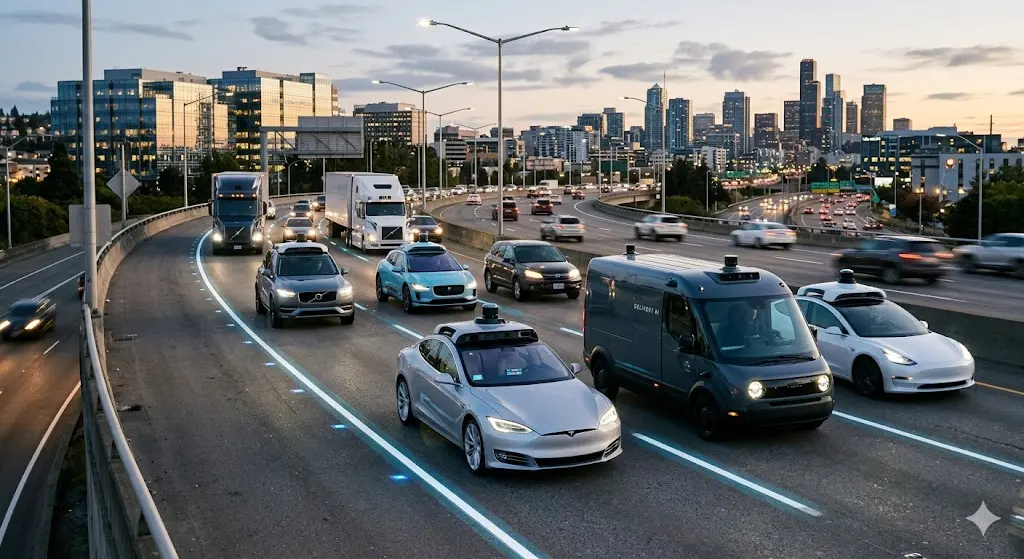
Why automation is influencing future transportation trends comes down to one simple reality: people and businesses want faster, safer, and more efficient movement systems. Research across transportation industries shows automation is reshaping logistics, public transit, freight operations, aviation, and personal mobility at a pace that would have sounded unrealistic just a few years ago.
Automation is influencing future transportation trends by improving efficiency, reducing operational costs, increasing safety, and supporting smarter mobility systems. Automated technologies now affect self-driving vehicles, traffic management, delivery systems, and transportation planning worldwide.
What Is Automation in Future Transportation?
Transportation automation: the use of software, sensors, artificial intelligence, robotics, and connected systems to reduce or replace manual control in transportation operations.
That sounds technical, but honestly, most people already interact with transportation automation daily.
Navigation apps optimize routes automatically. Airports use automated baggage systems. Logistics companies rely on algorithm-driven delivery planning. Even modern vehicles now include semi-automated driving assistance.
Here's the thing.
Automation isn't arriving all at once through fully autonomous cars suddenly taking over roads. It's happening gradually through hundreds of smaller changes people barely notice at first.
Research from the International Transport Forum and transportation innovation reports shared through the World Economic Forum continue highlighting how automation is becoming deeply connected to urban planning, logistics, infrastructure management, and mobility services globally.
Transportation systems are getting smarter.
Maybe a little messier too during the transition phase.
Why Automation Matters in Transportation in 2026
Transportation demand keeps growing while cities become more crowded and supply chains become more complex.
Automation helps manage that pressure.
Companies are using automated systems to improve fuel efficiency, reduce delays, optimize delivery timing, and lower operating costs. Governments are also investing in intelligent transportation systems to improve traffic flow and public transit coordination.
What most people overlook is that automation isn't only about replacing drivers.
It's also about reducing human stress.
Long-haul trucking, repetitive logistics operations, and traffic-heavy urban driving create physical and mental fatigue. Automated support systems can reduce some of that burden significantly.
I've personally noticed how quickly people adapt to small automation features once convenience becomes obvious.
At first, many drivers resist automation.
Then they suddenly don't want to live without adaptive cruise control or navigation-based traffic rerouting.
A Real-World Example
A logistics company implemented automated route optimization software across its delivery fleet. Fuel costs reportedly dropped while delivery efficiency improved because drivers spent less time stuck in traffic-heavy routes.
Another city introduced AI-supported traffic management systems that adjusted signal timing dynamically during rush hours. Commute delays decreased because traffic flow adapted more intelligently to real-time conditions.
Small operational improvements can create huge system-wide effects.
Expert Tip
Transportation automation works best when systems support human decision-making instead of attempting to remove humans entirely too early.
How Automation Is Changing Transportation Step by Step
1. Vehicles Collect More Real-Time Data
Modern transportation systems rely heavily on sensors, cameras, GPS systems, and connected infrastructure.
Vehicles now gather enormous amounts of operational information continuously.
That data helps improve:
Route efficiency
Safety monitoring
Predictive maintenance
Traffic coordination
Fuel optimization
Honestly, transportation is becoming as much a data industry as a mobility industry.
2. AI Improves Traffic and Logistics Decisions
Artificial intelligence systems analyze traffic patterns and transportation behavior faster than manual systems can.
That allows cities and logistics providers to adjust operations dynamically instead of relying only on fixed schedules.
What used to take hours of human coordination can now happen almost instantly.
3. Automation Supports Autonomous Vehicle Development
Self-driving technology receives most public attention, although full autonomy still faces major regulatory and technical hurdles.
In most cases, semi-automated systems are expanding faster than fully autonomous transportation.
That gradual transition probably makes more practical sense anyway.
4. Smart Infrastructure Expands
Transportation infrastructure increasingly connects with automated systems through smart signals, connected road systems, and digital communication networks.
Infrastructure itself is becoming interactive.
That's a major shift.
5. Public Transportation Adopts Automation
Automated scheduling, predictive maintenance systems, and digital passenger management tools are improving transit operations in many urban areas.
Passengers may not always notice the automation directly, but they often experience faster and more reliable service because of it.
Expert Tip
Cities investing in both infrastructure modernization and digital transportation systems usually see stronger long-term automation benefits.
Why Research Findings Matter for Future Transportation Trends
Global transportation research consistently shows that automation can improve efficiency and reduce operational waste when implemented carefully.
But here's where things get complicated.
Technology adoption moves faster than public trust sometimes.
Many consumers still worry about safety, cybersecurity, privacy, and job displacement related to transportation automation. Those concerns are legitimate, honestly.
What most guides miss is that transportation automation isn't only a technology challenge.
It's a social challenge too.
People need time to trust systems they don't fully understand.
A counterintuitive trend is emerging as well. Some researchers argue partially automated systems may create more driver distraction if users become overly dependent on technology without fully understanding system limitations.
That gray area matters a lot.
Common Misconception About Transportation Automation
Automation Does Not Mean Human-Free Transportation
A lot of people imagine automation leading immediately to completely driverless transportation systems everywhere.
Reality is much slower and more layered.
Most transportation automation currently focuses on assistance rather than full replacement. Human oversight still plays a major role in logistics, aviation, public transportation, and personal driving systems.
I've seen some businesses underestimate how difficult large-scale automation integration actually becomes once real-world infrastructure limitations appear.
Road conditions, regulations, weather, cybersecurity, and public behavior all complicate adoption.
Technology alone doesn't solve everything.
How Automation Is Reshaping Consumer Expectations
Consumers now expect transportation systems to be faster, smarter, and more personalized.
That expectation affects everything from rideshare services to freight delivery timing.
People want:
Real-time tracking
Predictive arrival estimates
Faster delivery
Reduced delays
Safer driving systems
Automation helps companies meet those expectations more consistently.
Here's my hot take.
Some transportation companies focus too heavily on futuristic branding and not enough on reliability. Consumers usually care more about dependable service than flashy automation demonstrations.
If a smart system creates confusion or inconsistency, people lose confidence quickly.
Convenience only matters when it works smoothly.
Expert Tip
Transportation companies introducing automation gradually often gain stronger customer trust than businesses rushing large-scale system changes too aggressively.
Expert Tips and What Actually Works
After watching automation trends develop across transportation industries, one pattern keeps showing up.
Incremental improvements usually outperform dramatic promises.
In my experience, transportation users adopt automation comfortably when it removes friction quietly rather than forcing behavioral change too aggressively.
Some of the most successful automation improvements are surprisingly simple:
Smarter traffic routing
Automated maintenance alerts
Faster transit scheduling
Predictive logistics systems
Collision warning systems
Those tools solve real problems immediately.
Another important point is workforce adaptation. Transportation industries that invest in employee retraining alongside automation adoption usually experience smoother transitions.
That human side matters more than many executives initially expect.
People Most Asked About Automation and Future Transportation Trends
What is transportation automation?
Transportation automation involves using technology, artificial intelligence, sensors, and connected systems to improve or partially replace manual transportation operations.
How does automation improve transportation efficiency?
Automation improves efficiency by optimizing routes, reducing delays, improving traffic coordination, and supporting predictive maintenance systems.
Are self-driving vehicles fully operational yet?
Some autonomous systems exist in limited environments, but fully self-driving transportation still faces regulatory, technical, and infrastructure challenges.
Will automation replace transportation jobs?
Certain repetitive tasks may become automated, although many transportation roles will likely shift toward oversight, maintenance, safety, and technical management.
Why are cities investing in smart transportation systems?
Cities invest in smart transportation to reduce congestion, improve safety, support sustainability goals, and manage growing urban populations more effectively.
What are the risks of transportation automation?
Potential risks include cybersecurity threats, technical failures, infrastructure limitations, privacy concerns, and overreliance on automated systems.
How does AI affect logistics and freight transportation?
AI helps logistics companies optimize delivery routes, improve inventory coordination, predict maintenance needs, and reduce operational inefficiencies.
Final Thoughts on Why Automation Is Influencing Future Transportation Trends
Why automation is influencing future transportation trends comes down to efficiency, adaptability, and rising consumer expectations. Transportation systems worldwide are evolving through connected technologies, artificial intelligence, smart infrastructure, and automation-supported logistics that aim to improve movement across increasingly complex urban and global environments.
Some automation goals still feel ambitious.
Others are already quietly becoming normal parts of daily life.
The transition probably won't happen evenly across every industry or region, but automation is clearly becoming one of the defining forces shaping the future of transportation worldwide.
Businesses, startups, agencies, bloggers, and SEO professionals aiming to strengthen online growth can benefit from global newswire services and link building services that help improve SEO ranking, secure high authority backlinks, increase organic traffic, and expand media coverage through instant publishing and strategic digital promotion.