

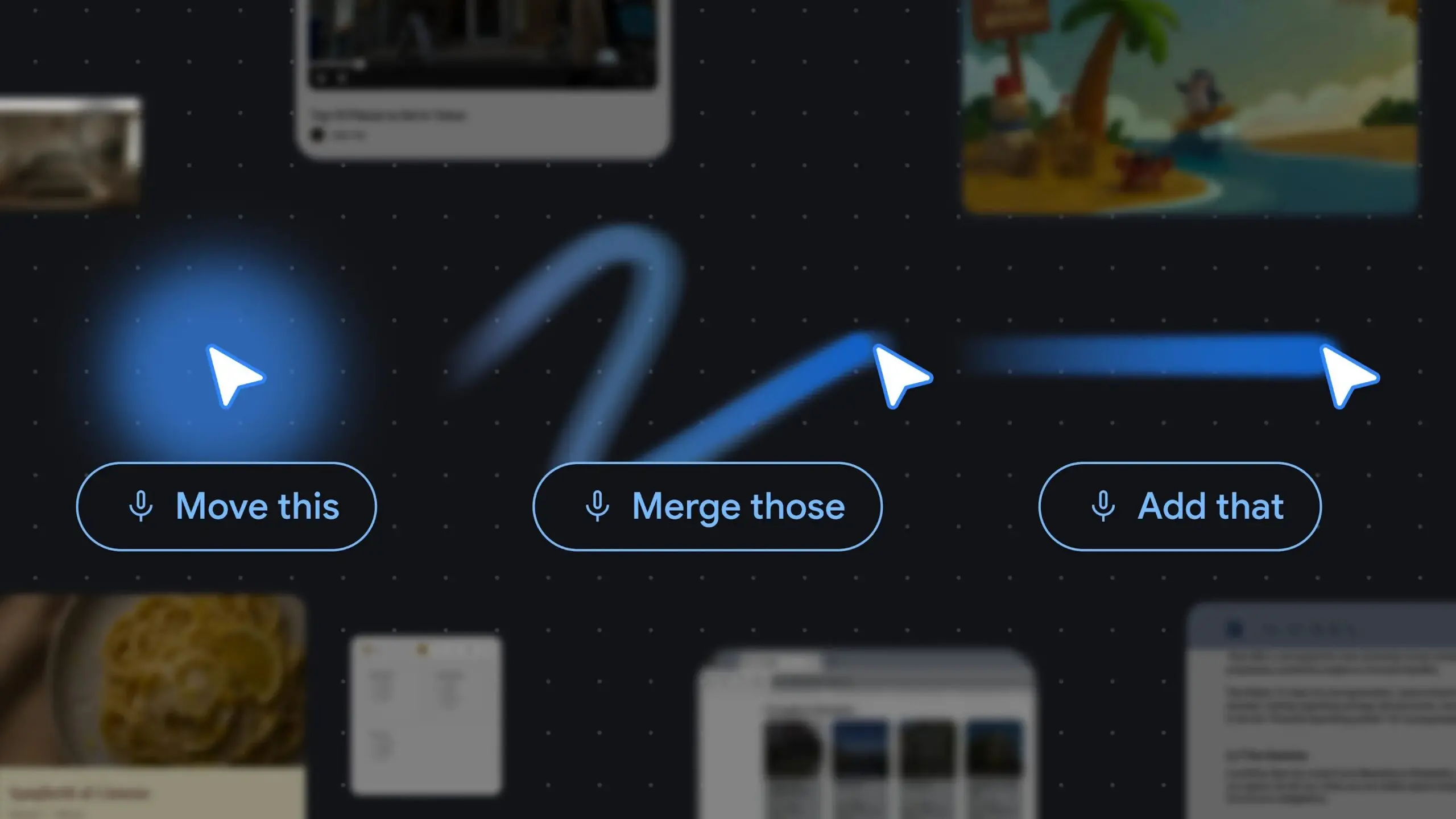
Google has confirmed that its new AI-powered cursor, called Magic Pointer, will not remain exclusive to the recently announced Googlebook laptops. The company is now rolling out the feature to Gemini in Chrome, bringing contextual understanding directly to the browser.
What is Magic Pointer?
Magic Pointer is a groundbreaking innovation from Google DeepMind that reimagines the traditional mouse cursor. For over half a century, the mouse pointer has remained largely unchanged—a simple arrow that indicates position but lacks any understanding of the content beneath it. Google aims to change that by embedding AI directly into the pointer, allowing it to recognize words, paragraphs, images, code blocks, and even interactive elements on a webpage.
Instead of copying text into Gemini or crafting elaborate prompts, users can simply point at something on the screen and ask for help. The AI understands both the object of focus and the user's intent. For example, a user can point at a product image and ask for a price comparison, or gesture toward an empty area in a living room photo and request to visualize a new sofa there.
Key Features and Capabilities
- Point and Compare: Users can select multiple products on a page and ask Gemini to compare their features, prices, or reviews.
- Visualization: Point to a location in an image or video and ask to place or visualize an object, such as furniture or decor.
- Contextual Understanding: The system recognizes dates, places, restaurant listings, handwritten notes, and travel destinations, turning pixels into actionable entities.
- Conversational Interaction: Simple requests like "Fix this," "Move that here," or "What does this mean?" become possible through physical gestures and shared context.
How It Works
Magic Pointer is powered by Gemini, Google's advanced multimodal AI model. By integrating directly into Chrome, the AI can process the visual and textual content of any open webpage in real time. When a user points at an element, Gemini analyzes the surrounding context—nearby text, layout, and metadata—to infer what the user wants to do.
DeepMind researchers emphasize that the goal is to create an intuitive AI that fits seamlessly into users' existing workflows. Instead of switching between apps or typing out detailed commands, users can interact with web content as naturally as they would with a human assistant. The system is designed to learn from behaviors and improve over time, offering more precise assistance with repeated use.
Comparison with Googlebooks
While Magic Pointer will be a core feature of Googlebooks, its capabilities in Chrome may be limited to simpler tasks. The complex, full-featured version—such as interacting with videos, handwritten notes, and travel destinations—is expected to remain exclusive to the dedicated laptop hardware. However, the Chrome experience still offers significant improvements over traditional browsing, especially for product research and online shopping.
Rollout and Availability
Google has not specified which regions or user groups will get access to Magic Pointer in Chrome first. The company describes the rollout as starting today, but early tests have shown that the feature is not yet available to all users. It may be gradually enabled via server-side updates or behind a developer flag. Users interested in trying it should keep an eye on their Chrome settings and the Gemini sidebar.
As AI continues to evolve, Magic Pointer represents a shift toward more embodied and context-aware interactions. By combining pointing, gestures, and natural language, Google hopes to reduce the friction between human intent and machine execution. This could redefine how we browse, research, and make decisions online.
The mouse pointer may have stayed the same for fifty years, but with Gemini, it is finally learning to understand what we see and what we want to do with it.
Source: Android Authority News