

Hackathon Overview
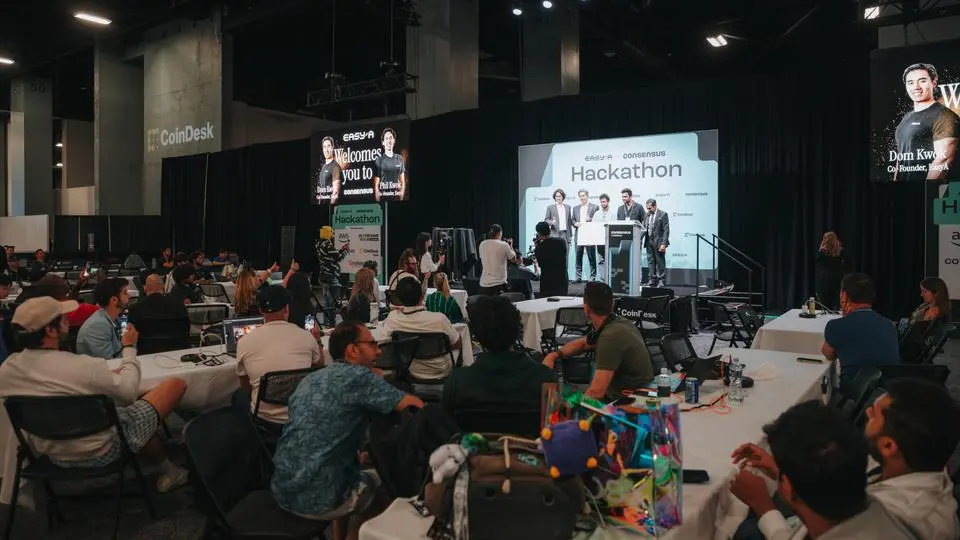
The 2026 EasyA hackathon at Consensus Miami saw an unprecedented surge of activity centered on artificial intelligence agents. Nearly 1,000 developers crammed into the venue, representing major blockchain ecosystems such as Base and Solana, as well as engineers from tech giants Microsoft and Google. The theme of the competition was clear: AI agents are the next frontier for crypto adoption.
Participants formed teams on the spot, brainstormed ideas, and coded furiously for 48 hours. The resulting projects ranged from autonomous payment systems that let AI agents transact on behalf of users, to consumer apps that used large language models to simplify DeFi interactions. Some teams built hardware integration, allowing drones to be controlled via smart contracts, while others created onchain prediction markets where AI models bet on real-world outcomes.
Key Projects and Themes
One standout project was a decentralized autonomous payment network that allows any AI agent to create and fund a crypto wallet. The system uses smart contracts to authorize transactions only when certain conditions are met, such as a signed message from a verified oracle. Another team focused on the consumer side: an AI-powered wallet that interprets natural language commands and executes complex swaps across multiple chains.
The drone coordination project captured the imagination of many attendees. By linking a drone's flight controller to a blockchain oracle, the team enabled autonomous drone fleets that can be rented and paid via stablecoins. This blurs the line between the digital and physical worlds, a concept that EasyA co-founder Dom Kwok called “the ultimate expression of verifiability.”
Developer Participation and Ecosystem Growth
EasyA has long been a breeding ground for crypto talent, but this year's hackathon felt different. The presence of engineers from Microsoft and Google signaled that traditional tech companies are actively scouting for blockchain applications. Many participants were attending their first crypto hackathon, drawn by the promise of AI. “I wanted to see what the intersection of large language models and smart contracts really looks like,” said a software engineer from Microsoft who asked not to be named. “I was not disappointed.”
Base, an Ethereum layer-2 scaling solution co-created by Coinbase, provided dedicated infrastructure for the event. Its chief developer advocate noted that Base's low fees and fast finality made it ideal for AI-driven microtransactions. Solana, known for its high throughput, attracted teams building real-time trading bots and prediction markets that required sub-second confirmations.
Past Successes Validate the Launchpad Model
Dom Kwok and his brother Philip Kwok, co-founders of EasyA, said the hackathon has evolved from a simple coding competition into a genuine startup launchpad. They pointed to several past winners that went on to raise venture funding from top firms. One project, a decentralized options exchange, secured a seed round led by a16z. Another, a cross-chain bridge protocol, entered Y Combinator and later raised $8 million. A third, a DeFi lending platform for real-world assets, is now valued at over $1 billion.
“We are building the next generation of unicorns right here,” Philip Kwok said. “The talent pool is deeper than ever, and AI is the accelerant. In the next three years, I expect multiple companies born at EasyA hackathons to reach billion-dollar valuations.”
The Broader Context: AI and Crypto Convergence
The hackathon reflects a wider trend of AI agents entering the crypto ecosystem. Several established projects, such as Fetch.ai and Autonolas, have pioneered agent-based frameworks, but the EasyA event showed that the concept has become accessible to a new wave of developers. The ability to rapidly prototype AI-native dApps on testnets and then deploy them on mainnets has lowered the barrier to entry.
Industry observers note that AI agents could solve some of crypto's biggest challenges, such as user onboarding, risk management, and market making. An AI agent that can analyze onchain data and execute trades without human intervention might outperform manual traders. However, concerns about alignment, security, and accountability remain. The hackathon judges emphasized that projects must include proper kill switches and governance mechanisms.
Diverse Use Cases on Display
Beyond financial applications, the hackathon featured projects in supply chain management, identity verification, and charitable donations. One team built an agent that automatically donates a percentage of its trading profits to verified charities on the blockchain. Another created a decentralized reputation system where AI agents rate each other based on past performance, creating a trust layer for automated interactions.
Impressive Scale and Future Outlook
The event's scale was notable. With nearly 1,000 participants, it was one of the largest crypto hackathons ever held. Organizers had to set up overflow rooms and additional power strips. Food and drinks ran out by the second night, a testament to the intensity of the competition. The final presentations took place on the main stage of Consensus Miami, drawing hundreds of spectators.
Looking ahead, the EasyA team plans to host similar hackathons in Asia and Europe later this year, each with an AI focus. They are also launching an accelerator program that will invest up to $500,000 in winning teams that decide to incorporate. The Kwoks believe that the combination of AI and crypto will produce the most innovative startups of the next decade.
As the hackathon wrapped up, the winners were announced: the autonomous payment network took first place, the drone coordination project won the base ecosystem prize, and the prediction market platform received a special award from Google engineers. All winning teams received tokens, mentorship, and introductions to venture capitalists.
The energy in the room was palpable. Developers were already discussing next year's event, brainstorming ideas that leveraged even more advanced AI models. The synergy between artificial intelligence and blockchain technology, once a niche interest, has become a mainstream movement — and the EasyA hackathon at Consensus Miami proved that the future is being built now.
Source: Coindesk News