

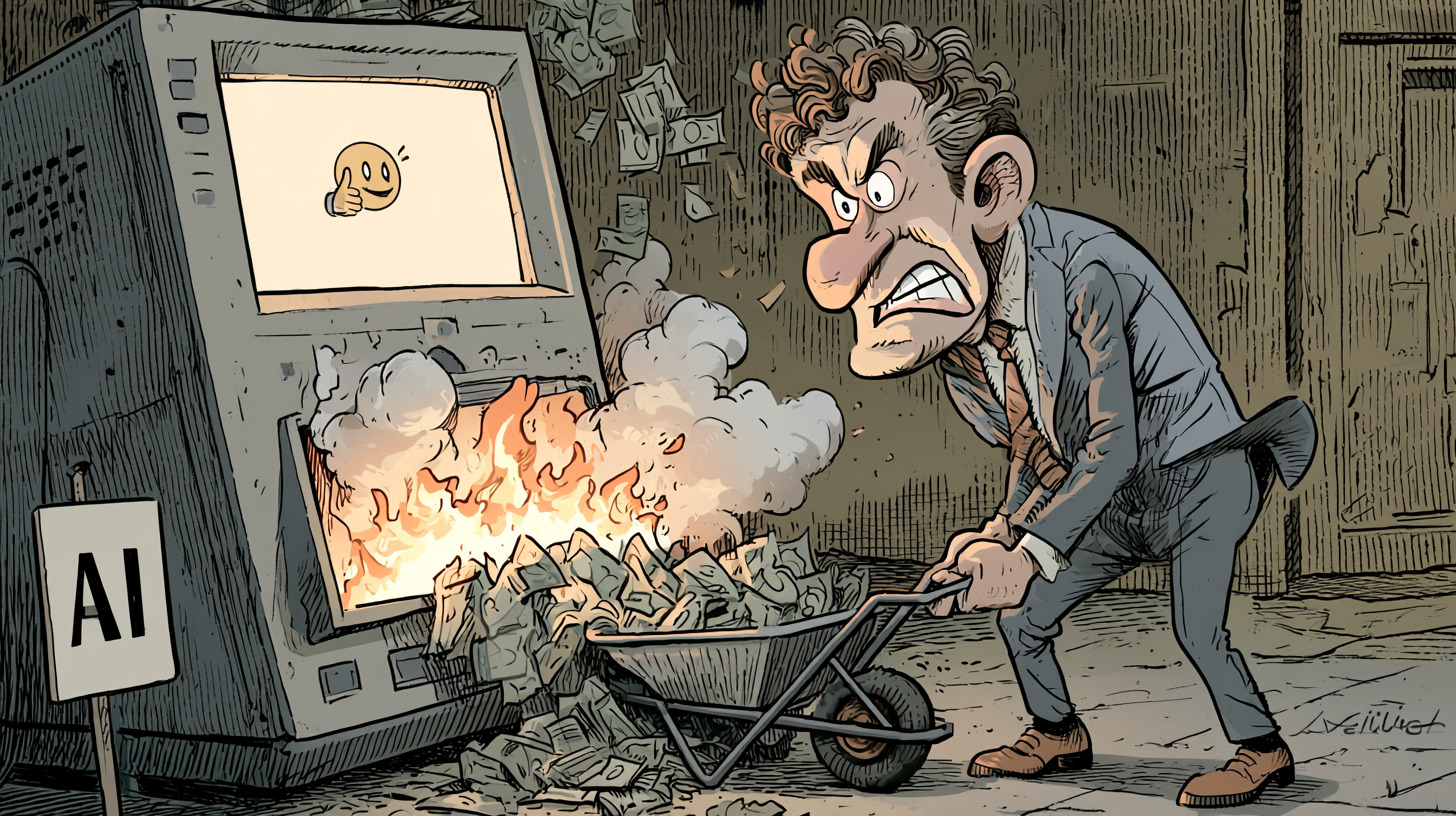
A company reportedly burned through $500 million in Claude AI credits in just one month after failing to set usage limits for employees, according to an Axios report. This staggering expense has become a cautionary tale for enterprises embracing generative AI without proper guardrails. The incident underscores a growing concern among corporate leaders that AI's promised cost savings may be an illusion, as unchecked usage leads to massive bills.
The report did not name the company, but it noted that employees had free rein to generate responses, write code, and create content using Anthropic's Claude model. Without any caps or monitoring, the credits were consumed at an alarming rate. This case is not isolated; many companies are struggling to balance AI adoption with budget control. Uber, for instance, recently revealed that its engineers had already exhausted their AI budget for 2026, and new COO Andrew Macdonald criticized the lack of productivity improvement relative to token usage.
The tokenmaxxing phenomenon
The term 'tokenmaxxing' has emerged to describe the tendency to burn through AI credits as fast as possible, often without clear business justification. This practice has become widespread, especially among employees who see AI tools as unlimited resources. The result is rapidly escalating costs for cloud compute, API calls, and subscription fees. Gartner reports that while inference costs for generative AI models are expected to drop to a tenth of 2025 levels by 2030, token usage could grow 5 to 30 times over the same period. That means the total cost may not decrease significantly, especially if companies do not impose limits.
Corporate leaders are starting to push back. Costco, Delta Airlines, and IBM have publicly expressed skepticism about AI's return on investment. Even Microsoft, a major AI proponent, has begun canceling Claude subscriptions and discouraging excessive use among its staff—just six months after encouraging employees to 'vibe-code'. This reversal highlights the tension between AI's potential and its practical cost implications.
Why AI costs are spiraling
Generative AI models require enormous computational power, especially during inference. Each query consumes tokens, and pricing is usually per token. For large enterprises with thousands of employees using AI for content generation, data analysis, or coding, the cumulative cost can quickly reach millions. In the case of the unnamed company, the lack of limits allowed employees to use Claude for non-business tasks, including personal creative writing or experimentation, which drained credits.
Providers like Google and Anthropic have shifted to usage-based billing, which can surprise companies that signed up expecting flat fees. This has caused agitation among non-enterprise users, who now face unexpected charges. The incident has prompted many organizations to implement strict AI usage policies, including token budgets per employee, approval workflows for high-cost queries, and monitoring dashboards.
Historical context of AI spending
Since the release of ChatGPT in late 2022, enterprises have rushed to integrate AI into their operations, often without conducting thorough cost-benefit analyses. The initial hype focused on productivity gains and automation, but the hidden costs of training, inference, and maintenance have become apparent. According to industry analysts, many companies underestimated the expense of running large language models at scale. For example, a Fortune 500 company might spend $10 million annually on AI API calls if usage is unconstrained. The $500 million figure—though extreme—shows the potential for runaway expenses.
This is not the first time such an incident has occurred. In 2024, a startup reportedly generated millions of dollars in cloud AI bills after a junior employee left a script running overnight. The new report suggests that enterprises are still learning to manage AI costs effectively.
Impact on AI adoption and investment
The mounting costs have led to a shift in corporate strategy. Companies are now emphasizing 'responsible AI' frameworks that include cost management. Some are limiting AI use to specific tasks such as customer service chatbots, which have clearer ROI, rather than allowing broad access. Others are investing in smaller, more specialized models that are cheaper to run.
Venture capital funding for AI startups may also be affected, as investors become wary of companies that burn cash on compute. The AI bubble, as some call it, may not burst, but it is certainly deflating. The dream of AI as a cheap, ubiquitous productivity tool is giving way to a more sober reality: AI requires careful planning and budgeting.
Gartner's report suggests that inference costs will drop by 2030, but that does not guarantee cost reduction if usage grows exponentially. The key will be for enterprises to set intelligent limits and prioritize high-value use cases.
Examples from other companies
Several other firms have faced similar challenges. As mentioned, Uber's engineering team exhausted its 2026 AI budget early, leading to restrictions. McDonald's recently scaled back its AI drive-thru ordering pilot after customers complained of errors and high operational costs. IBM has publicly stated that it values human workers over AI automation for many roles, and Costco has resisted adding AI-powered checkout systems, citing complexity and customer preference for human interaction.
Even cloud providers are adjusting their strategies. Google Cloud now offers tools to monitor and control AI spending, such as budget alerts and usage quotas. Anthropic also introduced tiered pricing and credit limits for enterprise accounts. These measures are meant to prevent another $500 million surprise.
The corporate world is also beginning to realize that AI does not automatically improve productivity. A study by Stanford researchers found that while AI can speed up certain tasks, it often introduces errors that require human oversight, negating some of the time savings. This has led to a more cautious adoption pace.
The road ahead
Despite the pushback, AI is unlikely to disappear from the workplace. Instead, enterprises will become more disciplined. They will train employees on cost-effective usage, implement strict policies, and track ROI more diligently. The incident of the $500 million Claude bill serves as a stark warning: without guardrails, AI costs can spiral out of control.
Providers will also evolve. We may see more usage-based models that cap exposure, or pre-purchased token bundles that expire. The market will likely consolidate around a few dominant players who can offer predictable pricing. Meanwhile, open-source models like Llama and Mistral may gain traction as cheaper alternatives for internal use.
In the end, the promise of AI remains strong, but the path to realizing it requires financial discipline. The era of unlimited AI experimentation is coming to an end. Companies that succeed will be those that balance innovation with cost management.
Source: Android Authority News